Kit basics for a winter outage
Kit basics come first. Illinois Winter Weather Preparedness Week runs November 9 to 13, 2026, according to the National Weather Service. Its first tip is to make sure your home emergency kit is stocked and winter storm ready. [1]
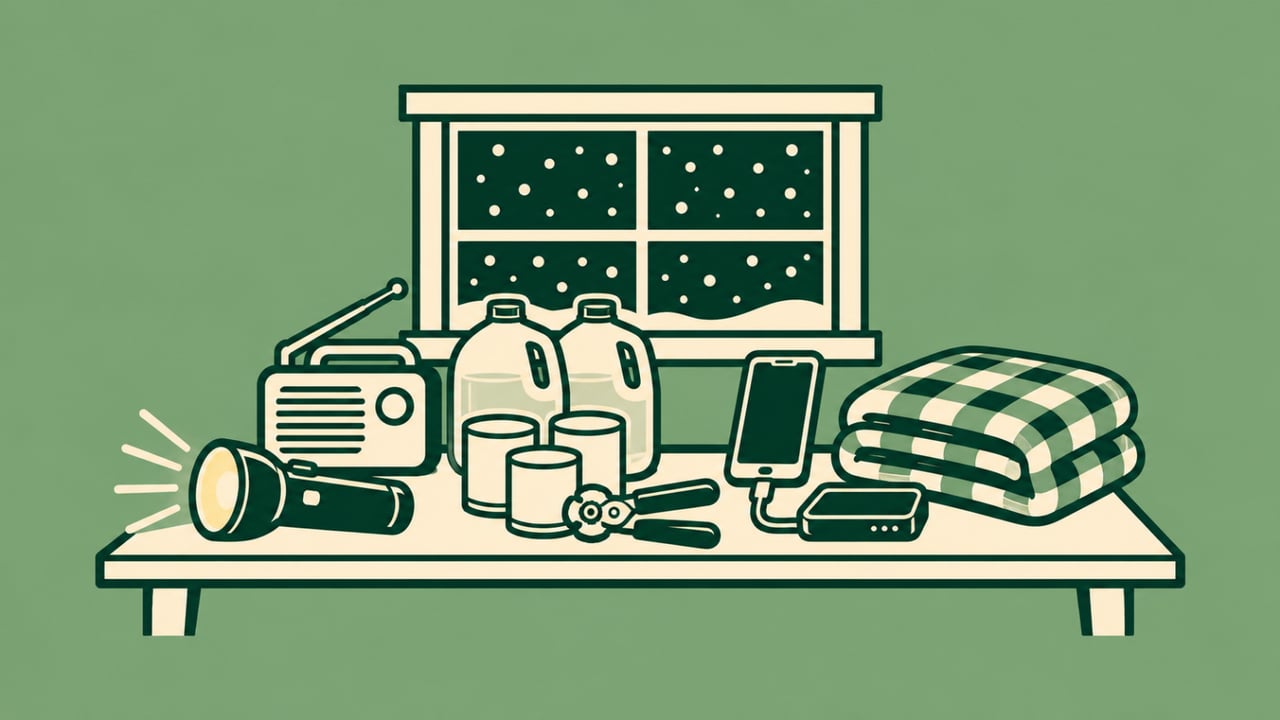
Ready.gov lists these basics for a home kit: [2]
- Water, one gallon per person per day for several days, for drinking and sanitation
- At least a several-day supply of non-perishable food, and a manual can opener
- A flashlight and extra batteries
- A battery-powered or hand-crank radio, and a NOAA Weather Radio with tone alert
- A first aid kit
- A cell phone with chargers and a backup battery
- A sleeping bag or warm blanket for each person
For winter, the Weather Service adds two more. Keep enough heating fuel on hand, because regular fuel sources may be cut off. And keep emergency heating equipment and fuel so at least one room of the house stays warm enough to live in. [1]
Keep the kit in one place, and make sure everyone in the house knows where it is. Ready.gov also says to replace expired items and rethink the kit every year. [2]
Alert sign-ups in Will and Grundy County
Alert sign-ups in Will County changed in 2026. Will County 9-1-1's Smart911 alert system replaces the Everbridge system, and the county expected the switch to be done by July 1, 2026, according to its June 16, 2026 announcement. [3]
If you got Will County alerts through Everbridge, you have to register again on Smart911 to keep getting local community alerts. [3] The county's notice names 13 local governments making the switch: Beecher, Braidwood, Crest Hill, Crete, Diamond, Joliet, Manhattan, Mokena, Monee, Rockdale, Romeoville, Wilmington and Troy Township. The Will County Emergency Management Agency is moving its emergency alerts to Smart911 as well. [3]
Smart911 sends alerts by text, phone call, email or app, for things like severe weather and road closures, and you can add more than one address. Sign up on the Will County 9-1-1 Smart911 page. [4]
In Grundy County, the Emergency Management Agency in Morris points people to its own app, in the iTunes App Store and the Google Play Store. It also lists its Facebook, Twitter and Nextdoor pages. [5]
If ComEd is your electric company, you can also sign up for its Outage Alerts by texting ADD OUTAGE to 26633. [7]
First minutes after the lights go out
In the first minutes after the lights go out, find out whether it is only your house. Ready Illinois, the state's preparedness site, says to check the fuse or breaker box for a blown fuse or a tripped breaker. Then check whether your neighbors are without power too. [8]
Use flashlights, not candles: Ready Illinois calls candles a fire hazard. [8] Then unplug appliances and electronics. Ready.gov says power can come back with surges or spikes that damage them. [9]
Reporting the outage to ComEd
Reporting an outage to ComEd can be done online, in the ComEd mobile app, by text, or by phone at 1-800-334-7661 (1-800-EDISON-1), 24 hours a day, 7 days a week. [6][7]
ComEd Outage Alerts subscribers can text OUT to 26633 to report an outage, then reply whether it is partial (flickering lights) or full. Texting STAT to 26633 returns the outage's status at any time. [7] ComEd also posts an outage map. [6]
Report it once. Ready Illinois asks people to call only once, to keep the line open for others. [8]
Stay away from a downed power line. ComEd says to leave the area right away and then call it. [6] The Red Cross says to stay at least 35 feet from a fallen line and anything it is touching. [10]
Heat without power: one warm room
Heat without power means keeping one room warm, not the whole house. The National Weather Service says to keep emergency heating equipment and fuel so at least one room stays warm enough to live in. [1]
Never heat the house with a gas stove or oven. Ready.gov says it raises the risk of carbon monoxide poisoning, fires and burns. [9] The Red Cross puts it this way: "Never use a generator, outdoor stoves or heaters indoors." [10]
A generator runs outdoors only, at least 20 feet from windows, doors and attached garages, according to Ready.gov. It also says to put carbon monoxide detectors with battery backup on every level of the home, and to let a generator cool before refueling. [9] The Illinois rules for where carbon monoxide alarms must go are in Smoke Detectors in Illinois: What Your Home Needs Before You Sell.
If the house gets too cold, go where there is heat. Ready.gov says to check with local officials about warming locations open near you. [9]
Fridge and freezer: keep the doors shut
The fridge and freezer stay cold longest with the doors shut. A closed refrigerator keeps food cold for about 4 hours, according to Ready.gov and the Red Cross. [9][10] A full freezer holds its temperature for about 48 hours, and a half-full one for about 24 hours, if the door stays closed. [10]
Keep a thermometer in the refrigerator and the freezer, and use coolers with ice if the outage runs long. [10]
When the power comes back, read the thermometer before anything else. Ready.gov says to throw away food that has been at 40 degrees or higher for two hours or more, or that has an unusual odor, color or texture. Its rule: when in doubt, throw it out. [9]
This week: three things to do
Illinois Winter Weather Preparedness Week is a good week to get three things done before the first big storm. Check your kit against the list above. Register for Smart911 if you live in Will County and were on Everbridge. And save ComEd's outage number in your phone, or text ADD OUTAGE to 26633 if ComEd is your electric company.